

TABLE OF CONTENTS
- Ingest Window
- Source Paths
- Setting a Destination
- Additional Options
- Ingest Destination Options - Source Directory Structure and Copy Photos
- Filter Files
- Applying Metadata Template on Ingest
- Local Template
- Rename Ingested Photos As
- Additional Options
- After Ingest
- Bottom Buttons
The workflow begins for many Photo Mechanic users with 'Ingest...' While there are many options on the Ingest window, the main job is to copy your images from a source (such as a camera card) to a destination (such as an external hard drive).
Ingest can automate tasks involved in getting your images from a source to the correct destination for your workflow, such as: renaming your images, adding metadata, creating folders, and keeping track of which images have already been copied. Since Ingest works as a background task, you won't have to wait for the ingest process to finish before you can work on your images.
As soon as Ingest has copied some images into the Primary Destination Path, a contact sheet will open to that location, by default.
Ingest Window
The ingest window can be accessed in several ways:
- Navigating to the File menu and selecting Ingest...
- Keyboard shortcut: Command+G (MacOS), Ctrl+G (Windows).
- When Inserting a camera memory card (see Auto Ingest below).
- When Photo Mechanic is launched (this is set in General Preferences).
To begin an ingest, you must select a Source to ingest from, and set a Destination for ingest to copy your images to.
You can begin to work while an ingest process is running in the background.
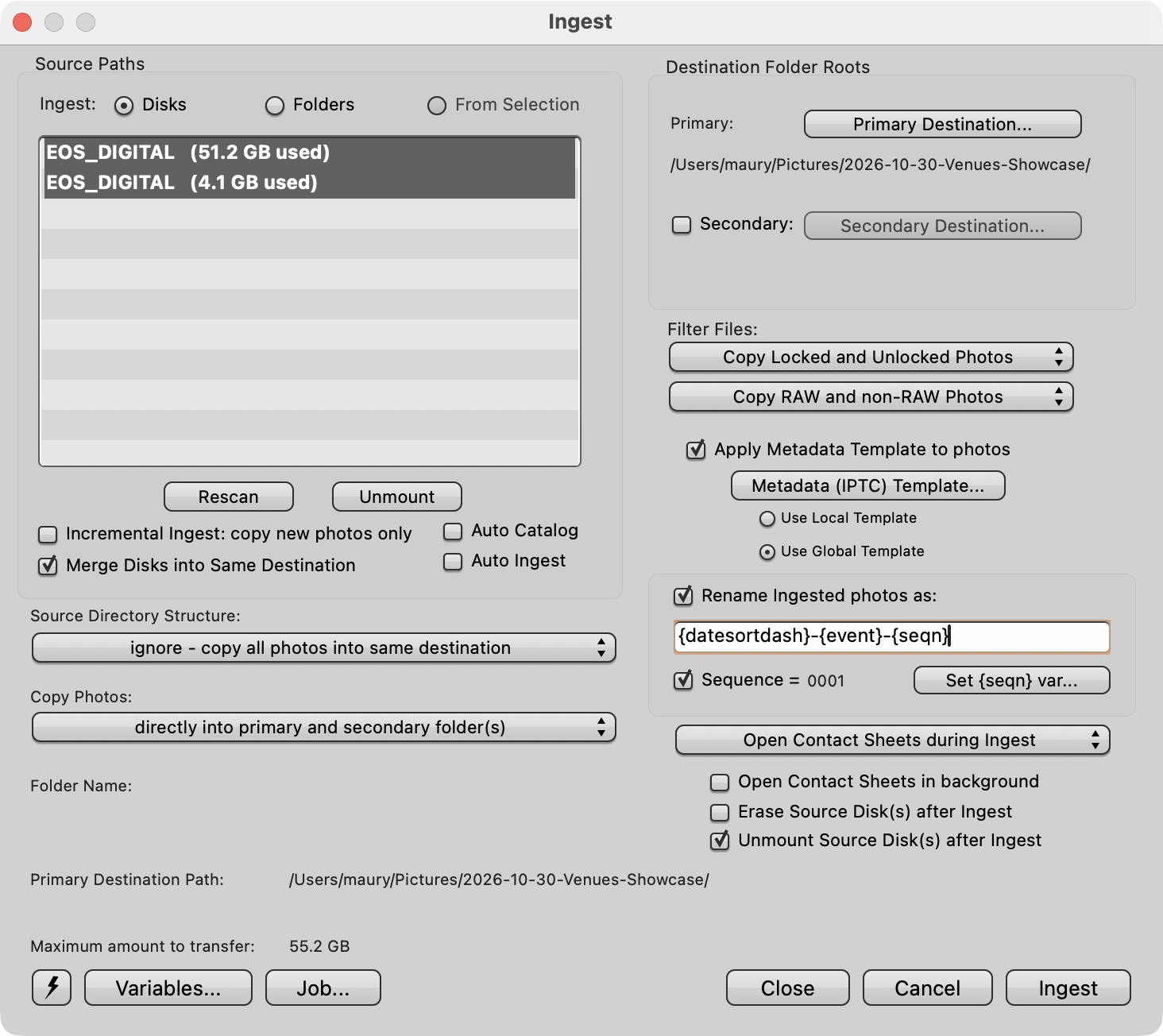
Source Paths
There are three types of sources that Photo Mechanic can ingest from.
- Disks- Will show all drives connected to your computer: memory cards (SD, CFExpress, CompactFlash, XQD, etc.), hard drives, and other connected drives
- The Rescan button will scan for any drives that are mounted to the computer but do not appear in the source list. Photo Mechanic should automatically show drives as soon as they are connected, but if you don't see them, select Rescan.
- The Unmount button will unmount the selected drive(s).
- To hide a volume from appearing in the Source Paths list, select that volume in the list, then press and hold the Modifier Key (Option on MacOS / Shift on Windows) - the Unmount button temporarily changes to Hide Volume - select the Hide Volume button.
- To un-hide a volume, you will need to delete the hidden file called ".pmingestignore" in the volume's root folder.
- To view hidden files in macOS's Finder, use Command-Shift-period.
- To view hidden files in Windows: Open File Explorer from the taskbar. Select View > Show, then select Hidden items to view hidden files and folders.
- Folders- Will show any folders that you have added to the list below as sources for Ingest.
- Select Add button to choose folders to add to the list of folders to use as an Ingest source.
- Select Remove to remove the selected folders from the list.
- From Selection - Will use the selection of images in the Contact Sheet as the source for the Ingest.
To ingest multiple disks or folders during a single session, hold Command on MacOS or Ctrl on Windows and while selecting each disk you would like to ingest.
Setting a Destination
To set a destination for Ingest to copy your images to, select Primary Destination...
- This will bring up your operating system's folder picker window, which will allow you to select a drive or folder to use as the primary destination
- If you would like to copy the contents of your Source to two locations, check the box for Secondary and select its destination.
- By default, Photo Mechanic will create a folder with today's date in the format of YYYYMMDD inside of your Primary (or Secondary) destination, however this is highly customizable. Read more below.
Once a Source has been selected and a Destination has been set, selecting the Ingest button at the bottom right of the window will begin the Ingest. By default, as soon as some files have been copied to your Primary destination, a contact sheet will open and can view the newly ingested images immediately while Photo Mechanic continues to work on the ingest task.
Additional Options
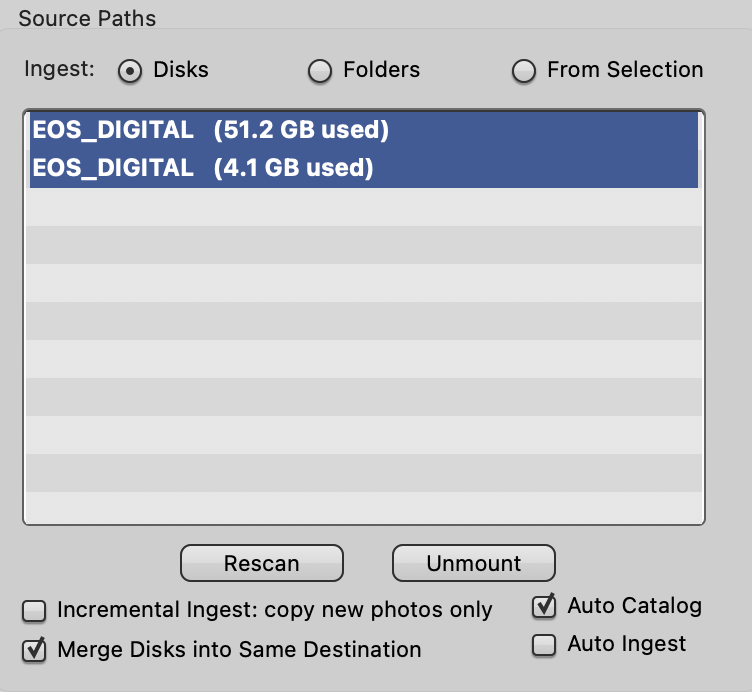
Incremental Ingest: When enabled, only new photos added to the ingest source(s) since the previous Ingest will be copied. Any time you perform an Ingest when this option is enabled, Photo Mechanic will keep a history of which images in the source(s) it has ingested.
Auto Ingest: With this option enabled, Photo Mechanic will automatically begin an Ingest when a camera card is mounted to your computer, using the most recent settings on the Ingest window. Note that in order for Auto Ingest to work, your General Preferences must be set to Show Ingest Dialog for the 'On mount of Camera Disk' settings.
Merge Folders into Same Destination: This option only appears when multiple items are selected in the Source list. For example, multiple memory cards can be ingested into the same Destination folder.
Auto Catalog: This option will only appear if you are using Photo Mechanic Plus and allows you to add your photos to your active catalogs as you ingest.
Ingest Destination Options - Source Directory Structure and Copy Photos
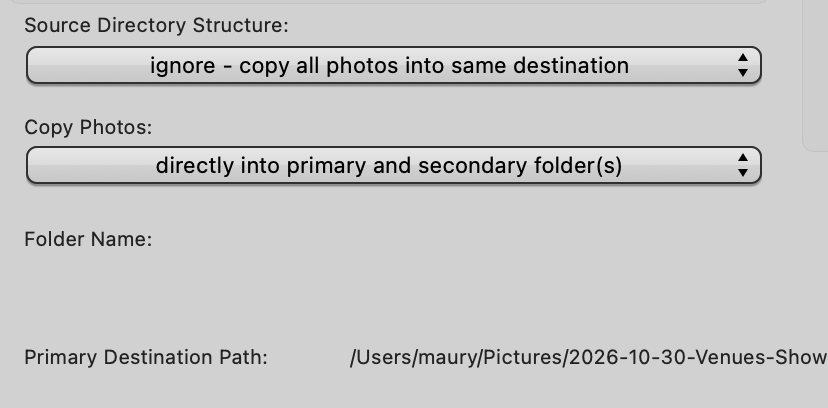
Below your source options are two drop-down menus which will determine what folders get created inside of your primary and secondary destination folders.
- Source Directory Structure- These options allow you to control if and how nested source folder names are copied while ingesting photos. Photo Mechanic will ingest the photos from nested folders no matter which of these options you choose.
- Ignore: the folder structure from the source will not be copied over to the destination
- Keep Separate source folder names only: includes the parent folder path that contains the images. IE: For images on the memory card stored in DCIM/100EOSR3/IMG_9999.CR3 and DCIM/101EOSR3/IMG_0001.CR3, the 100EOSR3 and 101EOSR3 folders will be created as sub-folders in the primary destination folder.
- Preserve all source directories: copies the entire folder structure on the source drive.
- Copy Photos - In addition to keeping or discarding the photo structure of your memory cards, you can choose to create sub-folders inside the Primary Destination/Secondary Destination or copy files directly into the primary and secondary folders.
Your choices to copy photos are:
- Directly into primary and secondary folder(s): Ingest will copy your images directly into the Primary Destination folder, as well as the Secondary if set in the Destination Folder Roots section.
- into dated folder only: Ingest will create a folder of the date that the Ingest is performed in the YYYYMMDD format.
- into folder with name: With this option selected, Ingest will create a folder with the text entered in the text box that appears under "Folder Name:". You can enter plain text for the folder name as well as incorporate variables to create folder names. You can optionally use the forward slash ' / ' character on macOS or the back slash ' \ ' character on Windows to create additional sub-folder structures inside the Primary (and Secondary) destination.
(IE: if the Primary Destination is set to the root folder of an external drive, in the 'Folder Name' textbox you can enter /Pictures/{year4}/{datesortdash} - Event Name Here/ to create a folder structure with a sub-folder called 'Pictures' inside the Primary Destination folder, a sub-folder in 'Pictures' with the four digit capture year according to the images' EXIF metadata, then a sub-folder inside the capture year folder with the name formatted as yyyy-mm-dd using the capture year, month, and day according to the images' EXIF metadata) - into dated folder with name: A combination of the two options above. A folder with the name entered into the "Folder Name" field will be created inside of a folder with the current date, and the dated folder will be created inside of the Primary (and Secondary) destination.
When using one of the options above that allow you enter text in your own folder name, there will also be a checkbox for Use Folder Sequence. With this option enabled, the {ingestsequence} variable will be added to the Folder Name textbox. This variable works much like the {seqn} variable. Instead of incrementing for every photo, it increments for each Selected Ingest source, or every completed Ingest.
Filter Files
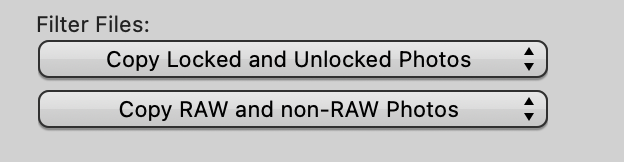
Ingest can be limited to copy only certain files from the source. By default, Photo Mechanic will not filter out any files, and Ingest will copy everything from the source.
- Filtering for locked or unlocked photos: Many camera models will allow you to lock files on your memory card to prevent deletion. Choose from the following options:
- Copy Locked and Unlocked Photos - Ingest will copy both locked and unlocked photos. Any locked files are ingested first.
- Copy Locked Photos Only - Only locked/protected files are ingested
- Copy Unlocked Photos Only - Only unlocked files are ingested
- Filtering for file type:Choose from the following options:
- Copy RAW and non-RAW photos
- Copy RAW Photos only
- Copy non-RAW Photos only
- Specifying non-RAW photos can help speed up an Ingest or could be used to separate video files from RAW files.
Applying Metadata Template on Ingest
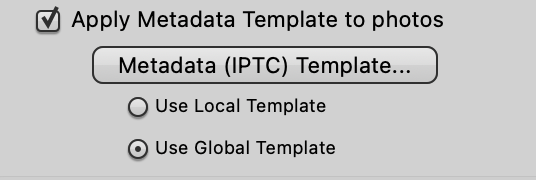
If you have a Metadata (IPTC) Template, you can apply the metadata to your ingest. Choose local (this ingest only) or global (for all uses of the Metadata Template throughout Photo Mechanic.)
Read more about the Metadata Template here: Using the Metadata (IPTC) Template.
When Apply Metadata Template to Photos is enabled, Photo Mechanic will apply the Local or Global Template, depending on which option you have selected beneath the Metadata (IPTC) Template button.
Local Template
When Ingesting images, you can use the Local or Global Metadata Template. The Local template is 'local' to the Ingest window. If Use Local Template is selected, choosing Metadata (IPTC) Template..." will open the local Template, and the local template will be applied on ingest. Conversely, when Use Global Template is selected, choosing Metadata (IPTC) Template... will open the global template. When the metadata template window is opened from anywhere else in Photo Mechanic, that will also use the Global Metadata Template.
Rename Ingested Photos As
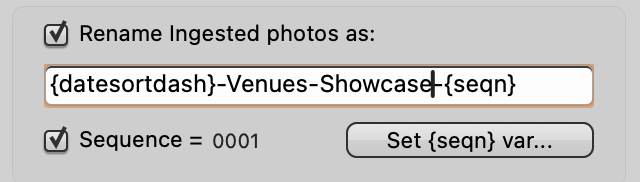
When this option is enabled, the files copied on ingest will be renamed according to your settings. Batch renaming is also available in the Copy/Move Photos utility and when using the Uploader. You can take advantage of the ingest process now to rename your photos from the defaults set by your camera. You can enter text, use variables, or use a combination.
Use the Sequence option to add a number count to each filename. Specify the first number in the photo count and how to increment. We recommend starting with 001 rather than 1. Note that Photo Mechanic will default to the last number you used between ingests until you reset it.
Additional Options
When to open contact sheets:
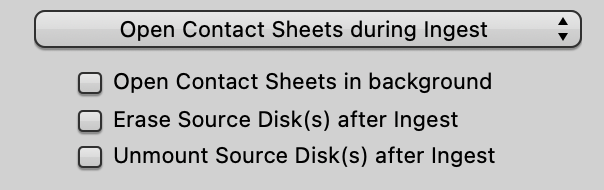
- Open Contact Sheets during Ingest - As soon as the Ingest operation copies some files to the destination, a Contact Sheet will open and display the newly copied images
- Open Contact Sheets after Ingest - The contact sheet for any Ingest destinations will only open once the Ingest has completed
- Never open Contact Sheets - Ingest will not open any Contact Sheets for you. You can still open a Contact Sheet using any of the methods described in Introduction to Photo Mechanic contact sheets
Open Contact Sheets in background: When this option is enabled, Photo Mechanic will follow your setting for when to open a new Contact Sheet (as set above), but will not make that Contact Sheet the active tab. Enabling this can be useful if you would like to keep a certain tab active while Photo Mechanic is working on an Ingest that creates multiple destination folders.
After Ingest
Erase Source Disk(s) after Ingest: With this option enabled, Photo Mechanic will erase any source disks once it successfully completes an ingest.
Unmount Source Disk after Ingest: Enabling this option ejects or unmounts the card after Ingest is finished. This option is only visible if you have Disks selected as your Ingest Source.
Bottom Buttons

- Lightning Bolt: Snapshots
- Variables: Shows the list of Photo Mechanic's variables. Read more about Variables here: Introduction to Photo Mechanic variables.
- Job: Opens the User/Client Variables panel
- Close: Close the Ingest window, saving any changes that were made since the Ingest window was open for next time
- Cancel: Close the Ingest window and discards all changes that were made on the Ingest window
- Ingest: Start the Ingest with the currently set options on the Ingest window.