
TABLE OF CONTENTS
- Applying New Metadata
- Modifying Existing Metadata
- Streamlining Your Workflow
- Using GPS Data
- Clearing Metadata Fields
The Metadata (IPTC) Template gives you control over applying IPTC metadata to efficiently add information to one or more photos. A Metadata Template can be applied to one or more images selected in a Contact Sheet, during Ingest, copying or moving images, uploading images, or when viewing an image's existing metadata in the Metadata (IPTC) Info window.
By default, the Metadata (IPTC) Template window contains every metadata field that Photo Mechanic supports displayed and enabled. If you would like to hide some fields so that only the ones that you need are displayed, you can do so in Accessibility preferences.
To view a list of descriptions for every metadata field and a field's associated variable, see Metadata (IPTC) Template Map.
Note: The Metadata (IPTC) Template was called the IPTC Stationery Pad in previous versions of Photo Mechanic.
Applying New Metadata
Enter relevant data into the textboxes of any metadata fields you wish to use. You can use variables or code replacements in these fields.
As soon as you start typing text or paste text into an empty textbox, the checkbox to the left of the field label name is selected. When the checkbox is selected, the field is modified when the Metadata Template is applied to the image(s). When the checkbox is clear, the associated field is not modified - any text in the textbox will remain in the textbox, but that text will not be applied to the image's respective metadata field.
Once you are satisfied with your changes, select the Apply Template to Selected button, or by use the keyboard shortcut: Command-Option-A (macOS) or Ctrl-Alt-A (Windows).

Modifying Existing Metadata
If you need to modify the metadata of a small amount of images, or modify specific information in one or two metadata fields, you can use the Metadata Info Tool (IPTC) to do so.
If you need to modify information in one or more metadata fields in a larger selection of images, using the Metadata Template will be quicker.
For most metadata fields, when the metadata field is applied to a selection of images, any existing metadata in the field will be replaced/overwritten.
Some metadata fields such as Description Writers, Keywords, and Persons Shown fields have an Append checkbox that, when selected, will append any text in the textbox after the last character of text that already exists in the associated metadata field for an image.
Select the checkmark next to the + icon if you want to append more metadata to a metadata field. Leave it clear if you want to delete the existing content and replace it with your new entry.
The Description/Caption field contains a dropdown menu. You can choose to replace the field (Replace), or insert new content before (Prefix) or after (Append) any existing metadata.
Streamlining Your Workflow
If you have a list of frequently used data, such as a list of photographers or subjects, you can use that information to create a custom dropdown list by selecting the dropdown arrow to the right of the field and selecting the Edit (Field Name Here)... option.

You can also import keywords from lists you have created or purchased.
You can save the content of an entire Metadata Templates for later use by saving Snapshots or by saving an .XMP template file.
To save a Snapshot, select the lightning bolt button at the bottom of the window. Give the Snapshot a unique name that briefly describes the contents of the Metadata Template to quickly find it at a later time.
To save the entire Metadata Template as an .XMP file, select the Save... button at the bottom of the window. A file browser window will open where you can choose the folder location you would like to save the file to.
Saving Metadata Templates to .XMP files allows you to quickly share Metadata Templates will other Photo Mechanic users or to create backups.
To load an XMP template file, select the Load... button next to the Save... button. A file browser window will open where you can navigate to the folder location of the XMP file.
Using GPS Data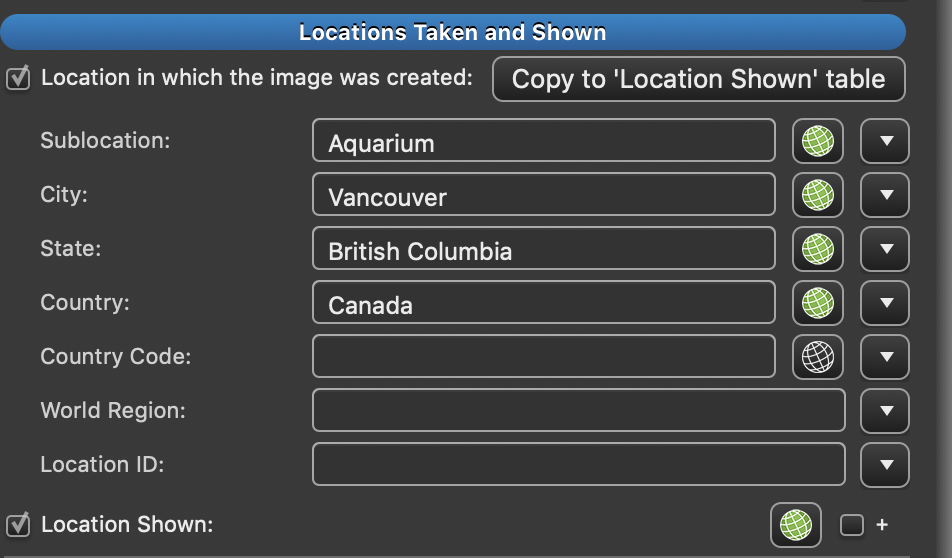
Photo Mechanic can use the GPS coordinates metadata stored in your images (whether added by the camera or Imported later) to populate location related fields with more human-readable location information such as the name of a city or state. This is called Reverse Geocoding.
Select the globe icon button next to location-based metadata fields that you would like to reverse geocode. When the globe is green, that indicates that Photo Mechanic will attempt to populate that field with reverse geocoded information. When a globe is selected, reverse geocoded data takes priority over any text you have entered. This means you can enter default location information that will only be applied if the image does not have existing GPS data.
Clearing Metadata Fields
To quickly erase the content in every metadata field, select the Clear button at the bottom of the window. Doing so will also clear the Apply checkbox to the left of the field label names.
You can choose which metadata fields are cleared and which Apply checkboxes are cleared by holding down the Modifier Key (Option on macOS / Shift on Windows) and selecting the Options button. When you hold down the Modifier Key, the Clear button changes to the Options button.
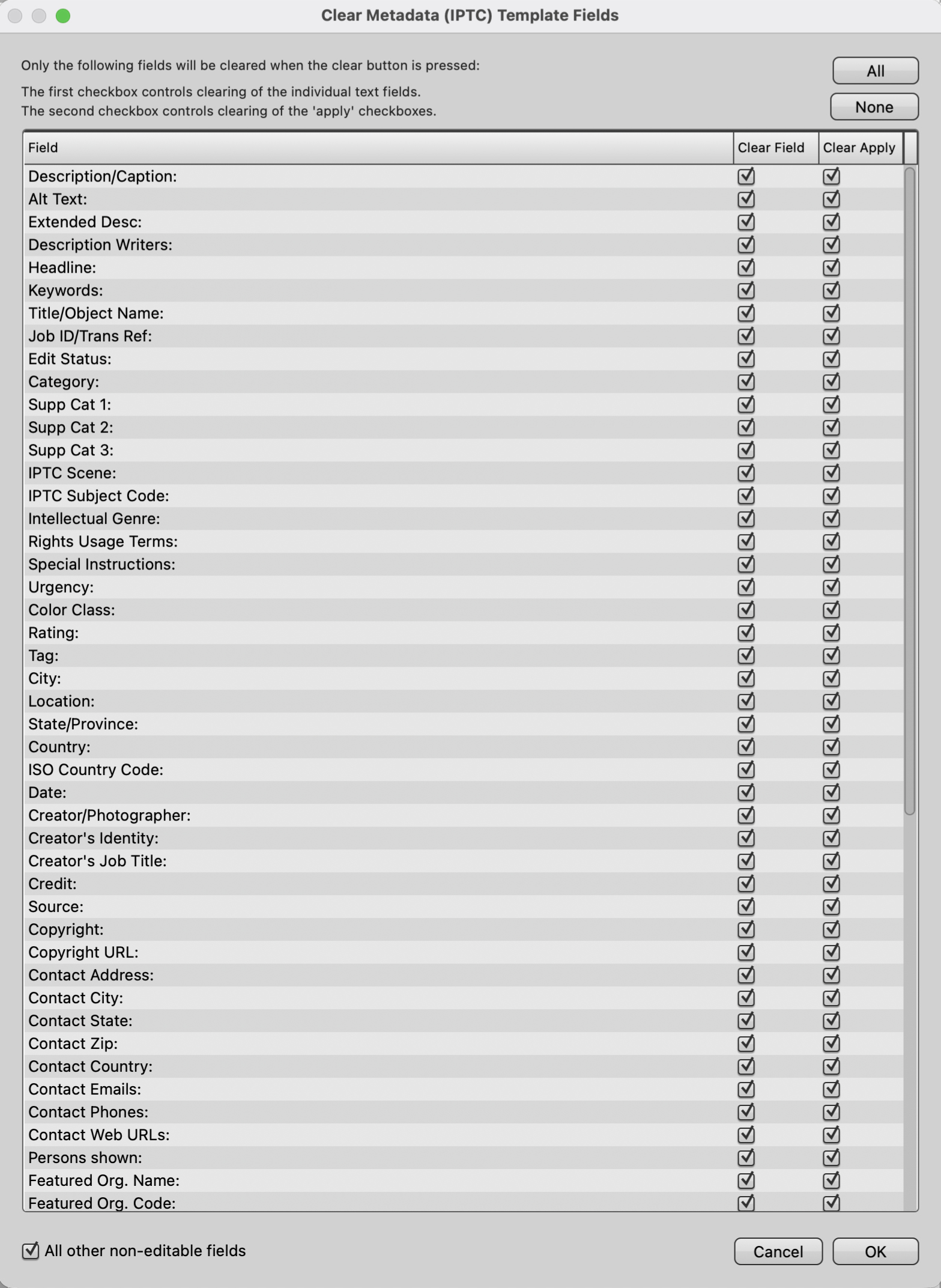
The Clear Metadata (IPTC) Template Fields window will appear.
To select all the checkboxes in the Clear Field and Clear Apply columns, select the All button.
To clear all of the checkboxes in the Clear Field and Clear Apply columns, select the None button.
The checkboxes in the Clear Field column control whether or not the textbox of a specific field is cleared when the Clear function occurs.
The checkboxes in the Clear Apply column control whether or not the 'apply' checkbox of a specific field is cleared when the Clear function occurs.